

Association of infant feeding practices in the general population with infant growth and stool characteristics.
Han et al. 2011 (Seoul, South Korea)Overview
This second clinical study provided additional data on the suitability of Whole Goat Milk Formula (WGF™) for infant growth and tolerance outcomes up to 12 months of age. It also investigated the relationship between infant feeding practices and detailed stool characteristics (a measure of gut health and tolerance). This study provided meaningful insights regarding the potential of WGF™ as an alternative to Cow Milk Formula (CMF) in diverse feeding scenarios. The bowel motions and stool characteristics of infants consuming WGF™ were more similar to those of breast-fed infants.
Methods
Principal Investigator: Professor Sang-Il Lee, Sungkyunkwan University, South Korea
Ethics approval: Samsung Medical Centre
Formulations: Commercially available New Zealand Whole Goat Milk Formula (20:80 whey to casein ratio; more than 50% total fat from goat milk) and commercially available CMF (Whey enhanced; none or negligible amount of milk fat).
This prospective cohort study was conducted in Seoul, South Korea, involving 976 full-term, healthy infants. Infants were retrospectively classified into five feeding groups based on their predominant diet during the first four months:
- Breast Milk Only
- WGF™ Only
- CMF Only
- Breast Milk + WGF™ Combination
- Breast Milk + CMF Combination
During routine medical assessments, data on feeding type, infant growth (weight and height), and stool frequency/consistency were collected at birth, four months, eight months, and twelve months. Mothers categorised stool characteristics using analogue scales.
Key findings
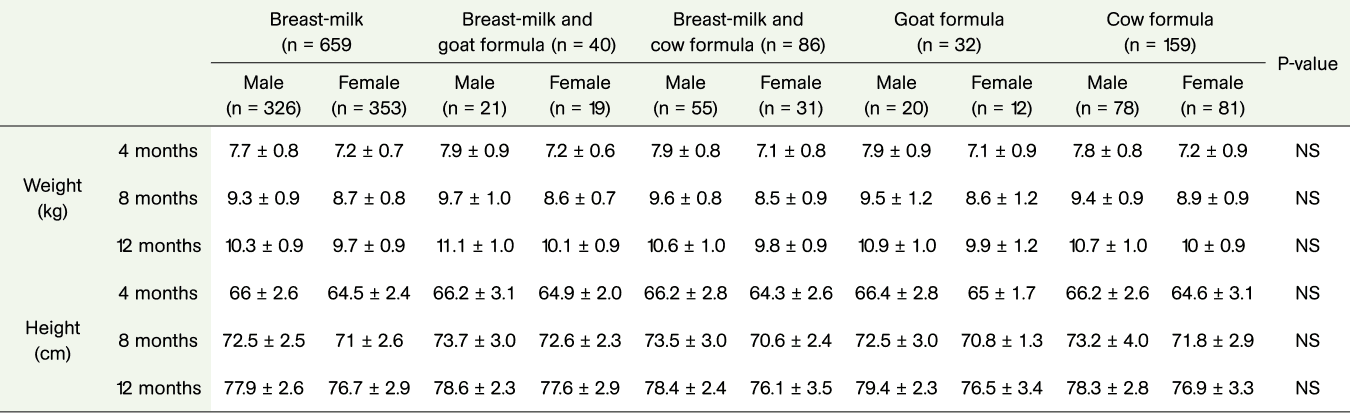
The growth rates (weight and height) of infants receiving WGF™ exclusively or combined with breast milk mirrored those of breastfed infants and those fed either a combination of breast milk and CMF or CMF only*.
Data on bowel motion frequency (3-7 per day) and consistency of stools (overall softer) were closer to those of breastfed infants.^†^ CMF-fed infants had fewer bowel motions (1-4 per day) and harder stool consistency than breastfed infants.^‡^ Analysis was undertaken for infants up to 4 months of age to avoid the confounding effects of other foods being introduced.

Conclusion
This study contributed to the evidence that whole goat milk formula is safe and suitable for feeding infants in the first 12 months of life. It provided new findings that infants fed WGF™ had similar bowel motions to those of breast-fed infants, suggesting that WGF™ may provide better gastrointestinal outcomes than CMF.
References
{small}ANOVA: analysis of variance; CMF: cow milk formula; WGF™: whole goat milk formula.{/small}
^*^All groups had similar growth outcomes to 12 months of age. P>0.05 for weight and height up to 12 months.
^†^P>0.05 for number of bowel movements and stool consistency between 0 and 4 months. Only data between 0 and 4 months were analysed because introducing other foods would confound the effects of breast or formula feeding on gastrointestinal function beyond 4 months.
^‡^CMF-fed infants were more likely to have only 1–2 bowel motions per day and less likely to have more than > 7 bowel motions per day than breastfed infants (P<0.05).
Han et al. {italic}Nutr Res Pract{/italic}. 2011; 5(4):308-312
Manufactured in New Zealand by:
Dairy Goat Co-operative (N.Z.) Limited.
18 Gallagher Dr, Hamilton,
New Zealand.