

64% Significantly Lower Risk Of Eczema in High Risk* Infants Fed Capricare®†
Grote et al.^1^ 2025 (Germany, Spain and Poland)New research confirms early findings of eczema protection
A large (n=2132) multi-centre, randomised, double-blind controlled trial of healthy, term, formula-fed infants confirmed that whole goat milk formula (WGF) can help protect infants from atopic dermatitis (AD)^†^, especially infants with a parental history* of AD^1^.
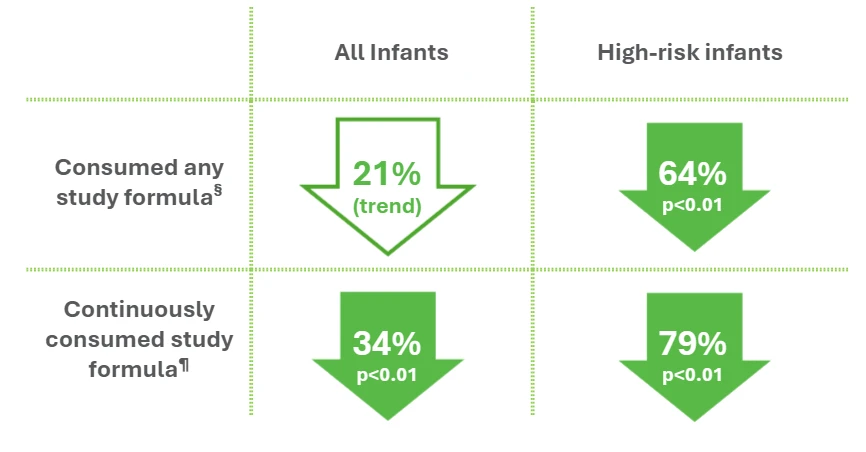
- When atopic dermatitis (AD), commonly referred to as eczema, was diagnosed by a doctor at any time over the 12-month intervention period, there was a significant 34% lower risk of eczema in infants who received WGF continuously throughout the study.
- Among infants with a parental history of AD (high-risk), when comparing whole goat milk formula (WGF) vs cow milk formula (CF), WGF was associated with a strong protective effect across all AD outcomes.
- A 64% significantly lower risk of developing AD diagnosed by a doctor at any time in the 12 months, in infants who received WGF and had a family history of AD.
- Formula choice did not affect the rate of AD diagnosis in all infants when stricter standardised diagnosis criteria were used at only 3 study visits^ᶲ^.
- There was no difference in the number of adverse events between the formulations
Reduction in the risk of AD^‡^ in infants fed whole goat milk formula vs whey-adjusted cow milk formula
Incidence rate of any AD diagnosis^¥^ in high-risk infants* up to 12 months
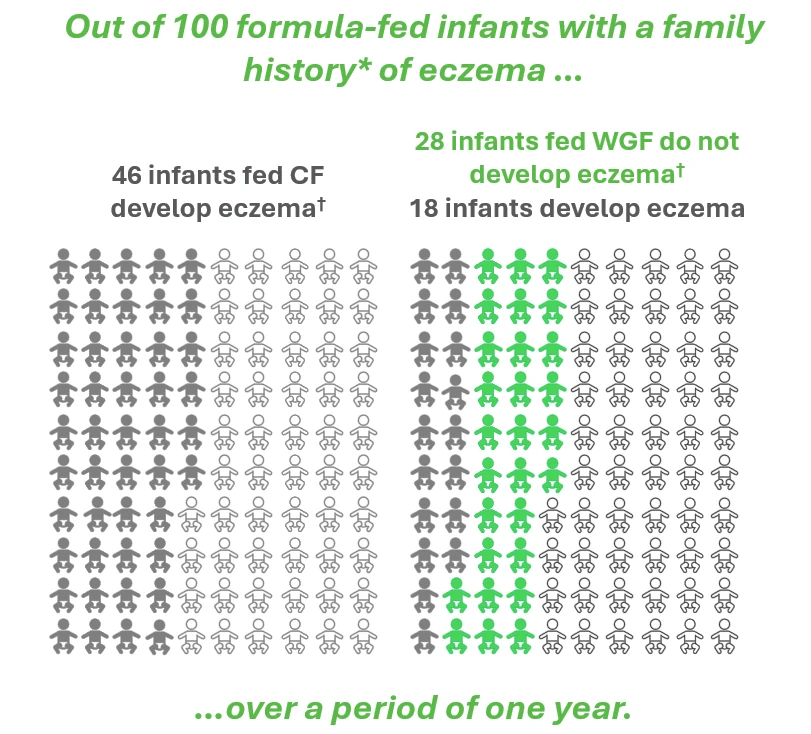
†Compared to standard whey-adjusted cow milk formula.
*Infants with ≥1 parent with a history of AD
^ᶲ^Diagnosis by UK Working Party adapted for infants (IRR: 1.00; 95% CI: 0.75, 1.32; P=0.991)
^‡^Diagnosis by a doctor at any time over the intervention period up to 12 months of age.
^§^Intention to treat (ITT) analysis included all infants who had at least one serving of study formula.
^¶^Per protocol (PP) analysis included all infants randomised who were compliant (no breaks of formula intake >3 days, no complementary feeding before 4 months) and no major protocol violations (all study visits)
^¥^ Infants with AD diagnosed by any of the four measures of AD used in the clinical study. Infants were only counted once.
Importance of this Clinical Study
This clinical trial demonstrates that WGF can markedly reduce the incidence of AD in formula-fed infants in the first year of life, especially if there is a parental history of AD.^1^
What Causes Infant Eczema?
Eczema is a common inflammatory skin disorder that affects 20% infants globally and presents as intense itching, recurrent eczematous skin lesions, and has a relapsing-remitting disease course^2^. Most cases of eczema appear in the first year of life and predispose children to other inflammatory conditions such as food allergies, asthma, and allergic rhinoconjunctivitis^3^.
Does Eczema Run in Families?
A family history of AD increases the risk of eczema in children by up to 3-fold. Preventing the onset of eczema is key to minimising its impact on the child and potential future allergic disease. To date, there have been limited nutritional interventions for formula-fed infants, with inconclusive evidence on hydrolysed formulas.
The results of the GIraFFE study suggest there is a significant opportunity to prevent allergy-related disease in formula-fed infants with a family history of AD.
GIraFFE Study design summary: Whole Goat Milk vs Cow Milk Formula
The GIraFFE Study investigated the impact of whole goat milk formula (WGF) compared with standard whey-adjusted cow milk formula (CF) on the incidence of atopic dermatitis (AD) in infants aged up to 12 months. It is one of the largest paediatric nutrition intervention studies ever conducted and is being delivered by internationally renowned clinical teams in Germany, Poland and Spain. The clinical study is registered at ClinicalTrials.gov (NCT04599946).

Control formula
Cow milk formula (CF) based on skim milk and added whey, with vegetable oils as the predominant fat source and only 5% of the fat from milk.

Summary of Results
Study Population
A total of 2,132 infants were recruited and randomly assigned to receive WGF (1,065) or CF (1,067) until 12 months of age. The WGF used whole goat milk as the sole protein source with no added whey and about equal fat contributions from goat milk and vegetable oils, whereas the CF was based on skim milk with added whey and fat derived predominantly from vegetable oils, with only ~5% from milk. The energy content and nutrient composition were matched.
The average age of infants at enrolment was 25.6 days. Overall attrition by 12 months was lower than expected at 12.6%. Baseline demographic and clinical characteristics were similar between the two groups.

Infants are Protected from Atopic Dermatitis when they Continuously Consume WGF for the First Year of Life.
Overall, 327 infants were diagnosed with AD. There was no difference in the incidence of eczema between the WGF and CF groups when AD was measured at 3 study visits (ADPrimary). However, when AD was diagnosed under real-world conditions, there was a significant protective effect of continuous feeding of WGF on infant eczema (ADDoctor and ADAny).
-
- Using the UKWP standardised diagnostic criteria for AD, no difference in eczema incidence between the WGF and CF groups was observed in either the ITT or PP populations (ADPrimary and ADUKWP).
- Based on clinical practice assessment (ADDoctor), AD incidence was lower in the WGF group than in the CF group (21% reduction; trend). A statistically significant 34% reduction was observed in infants who continuously consumed WGF (PP population; p < 0.01).
- In addition, when all infants assessed by any of the criteria were considered (ADAny), AD incidence was lower in the WGF group than in the CF group (trend), and a statistically significant reduction was observed in infants who continuously consumed WGF (PP population).
The findings show that AD incidence was lower in the WGF group than in the CF group. Further, better adherence to WGF, either as part of mixed feeding with breast milk or as the sole source of milk feeding, in the first year of life is associated with a greater reduction in the risk of eczema in babies.

WGF Provides Protection to Infants with a Family History of Eczema
A family history of AD is one of the strongest predictors of AD risk in offspring, increasing the risk by 2-3 times. In the GIraFFE Study, a parental history of doctor-diagnosed AD (at least one parent with a history of AD; high risk infants) was reported in 9.5% of participants.
Among infants with a parental history of AD (high risk), WGF compared with CF was associated with a strong protective effect across all AD outcomes.
-
- When applying the UKWP standardised diagnostic criteria for AD, the incidence of AD was reduced by more than 60% (trend; ADPrimary and ADUKWP).
- Based on clinical practice assessment (ADDoctor), which diagnoses infants at any time during their first year, the incidence of AD was 64% lower in the WGF group than in the CF group (p<0.01). The reduced incidence of AD in the WGF group was also statistically significant when all infants were considered (ADAny; 61%; p<0.01).
- A statistically significant reduction of >75% was observed in all measures for infants who consumed WGF (PP population; p < 0.01).
The protective effect observed in high-risk formula-fed infants is consistent with previous nutrition studies. Evidence from meta-analyses and intervention trials suggests that the benefits of probiotics, and hydrolysed formulas on AD risk are mainly confined to high-risk formula-fed infants.

Severity of AD: Disease severity was similar between groups. Most AD cases were mild to moderate, though a higher proportion of severe AD was observed among infants with a parental history of AD.
Adverse events: AE incidence was similar between groups (2,066 AEs; IRR 1.03, p=0.48).
The GIraFFE Study will follow the infants until 5 years of age to assess the long-term benefits of consuming WGF compared with CF in their first year of life.
References
- Grote et al. Clinical Nutrition 2026, In press, 106707
- Lloyd-Lavery et al. Review. Clin Exp Dermatol. 2019, 44(4):376-380
- Bieber. N Engl J Med. 2008, 358(14):1483-1494
- Osborn et al. Syst Rev. 2018, 10(10): Cd003664
Share this article:
Manufactured in New Zealand by:
Dairy Goat Co-operative (N.Z.) Limited.
18 Gallagher Dr, Hamilton,
New Zealand.